
Rearranging the fiscal furniture won’t mask the stains beneath
This year’s Spring Statement was an uneventful affair. The government trimmed spending at the margin, hoping to stay on track to balance current spending with tax receipts by the 2029/30 fiscal year. Instead of the usual set-piece budget statement putting up the cost of beer, wine and cigarettes, we saw an uninteresting exercise in shuffling money around planned government spending.
Anyone who has ever done a household budget, or some sort of cashflow forecast, knows that trying to predict the future is fraught with uncertainty. There is always something that throws your forecast out. As some accountants say, if you want to make God laugh, tell her your plans. Last October Rachel Reeves laid out her plans and promised to keep borrowing in very tight bounds so that by 2029/30 spending and tax receipts would be in balance, based on the Office for Budget Responsibility’s forecasts.
God has laughed, and six months later Reeves’ forecasts for 2029/30 are out by about £14bn. This, against planned government spending of £1,519bn in 2029/30 might not seem too bad, amounting to just 0.8% of the total. In the real world, it would make it a pretty good forecast, out slightly, due mainly to higher interest costs. However, in the straitjacket of the fiscal rules Labour have imposed upon themselves, corrective action is required. Given Labour’s past criticism of the Tories’ £22bn black hole, a £14bn shortfall would be unsightly, to say the least.
So, the Chancellor’s pledge to raise government spending by around 2% of GDP a year, on average, over the next five years, has been disrupted in the space of just six months. It is unsurprising that the government appears so fickle with its finances when it constrains itself within such rigid boundaries. Labour is balancing the need to appear fiscally responsible while also responding to political pressures. The latest budget changes show this balancing act is proving very difficult – the room to manoeuvre is so limited. They are forced to just rearrange the furniture.
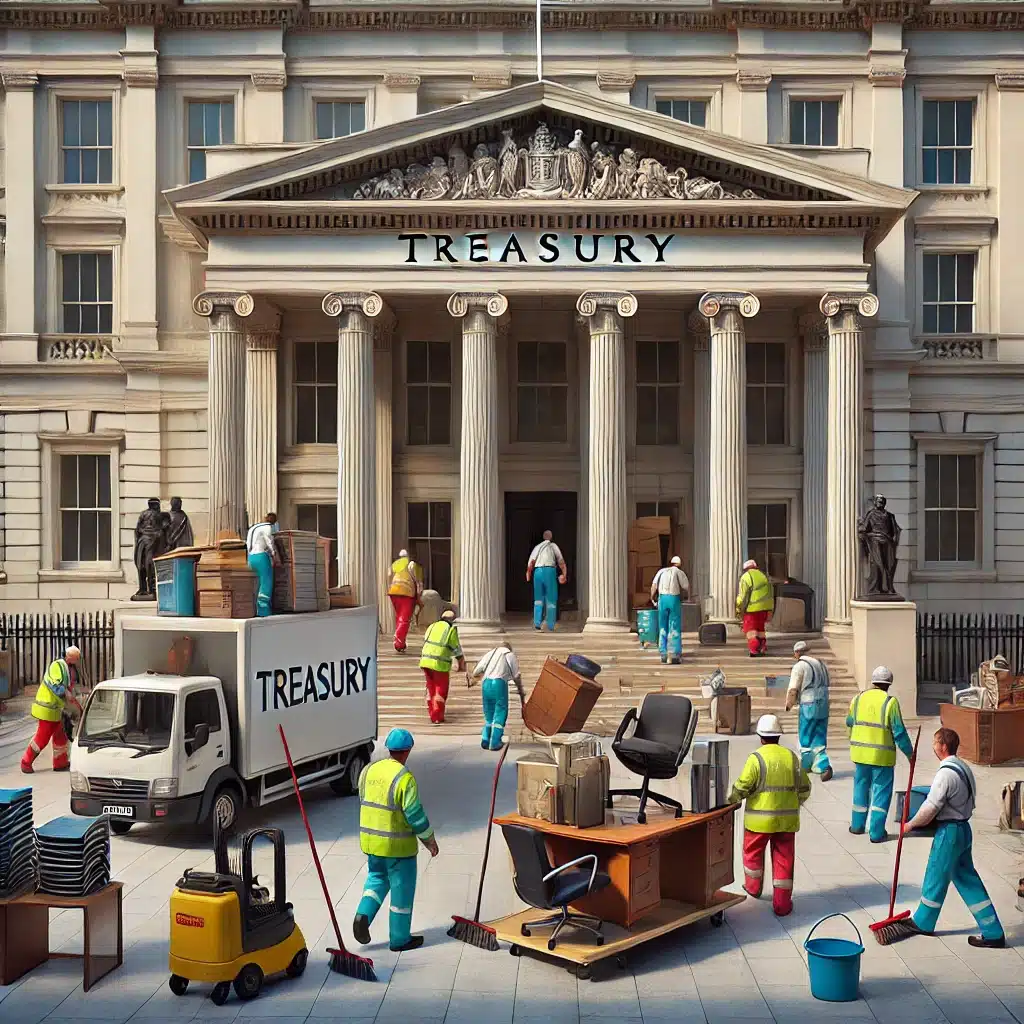
Source: ChatGPT
Rather than raise taxes then, the action has come in the form of cutting the welfare budget by about 1%, and by juggling some estimates. About net £5bn comes from cutting some benefits like the Personal Independence Payments and Universal Credit, with about £6bn in savings coming from the Civil Service, and greater tax compliance. A further £3.4bn in tax revenues is estimated to eventually come from accelerated house building under Labour’s recently announced National Planning Policy Framework.
Amid all the juggling and changes to estimates, the Treasury found an extra £2bn for defence, taking spending to 2.5% of GDP by 2027. In the light of the Signal security leak in the US this week, this extra spending will not impress the Americans at all, but in our changing world it is one of the few areas where governments on left and right agree. How it is implemented, however, and whether it will stand up to scrutiny from the electorate should the economic stagnation in the UK and Europe continue, is another question entirely.
It is surprising to see any Labour government cut benefits, but the belief that disability payments are being used incorrectly by those who are merely out of work was widely discussed beforehand. The UK has a stagnant economy, and cannot afford the rapidly increasing welfare payments it finds itself with. Some reform is necessary given that there is a limited supply of the very wealthy that can be taxed further.
The UK may also find itself on the receiving end of US tariffs come next week, should a deal with Trump not be struck. Much has been written about the tariffs the US president is imposing across the world, and the impact they might have on UK industries such as autos. As the map below shows, the UK is one of the few nations in Europe to run trade deficit with the US, meaning US goods would be more heavily impacted by those tariffs:

In this challenging environment, Reeves has appeared to stumble across some cash down the back of the sofa. The Office for Budget Responsibility gave £3.4bn credit to the December 2024 National Planning Policy Framework for housing. Labour is at pains to point out that the extra growth, and £3bn tax revenues it will generate, are gains that did not cost anything. This begs the question that if it did not cost anything, why it was not delivered years ago and what other steps can be taken to generate extra growth by relaxing rules and red tape in other areas? At least the mood music in this area from government is changing, although we have yet to see many tangible changes. Instead of journalists splitting hairs over minor forecast alterations, what the UK needs is more stability and flexibility.
The 2025 Spring Statement saw a lot of juggling over a small forecast error. Baked into the forecasts are some huge assumptions like a GDP growth rate of 1.9% in 2026, 1.8% in 2027, 1.7% in 2028 and 1.8% in 2029. Experience suggests that these forecasts are optimistic and that events will blow these forecasts off course. When that happens, it will take more than juggling, and we may see real pain from deep spending cuts and tax increases.

Please be aware that the value of investments may go up or down and you may receive back less than you invested originally. Past performance is not a guide to the future.
This document contains general information only and does not provide any advice or guidance specific to your personal circumstances.
Callanish Capital is authorised and regulated by the Financial Conduct Authority to manage investments but does not provide Financial Planning or Investment Advice. Please refer any such queries to your Financial Advisor.
This email and any accompanying attachment are issued by Callanish Capital Ltd, a company registered in England and Wales under company number 13182424. Registered Office: 45 Pont Street, London, SW1X 0BD.
Callanish Capital Ltd is a Discretionary Fund Manager, directly authorised and regulated by the Financial Conduct Authority (“FCA”) under registration number 955992.