
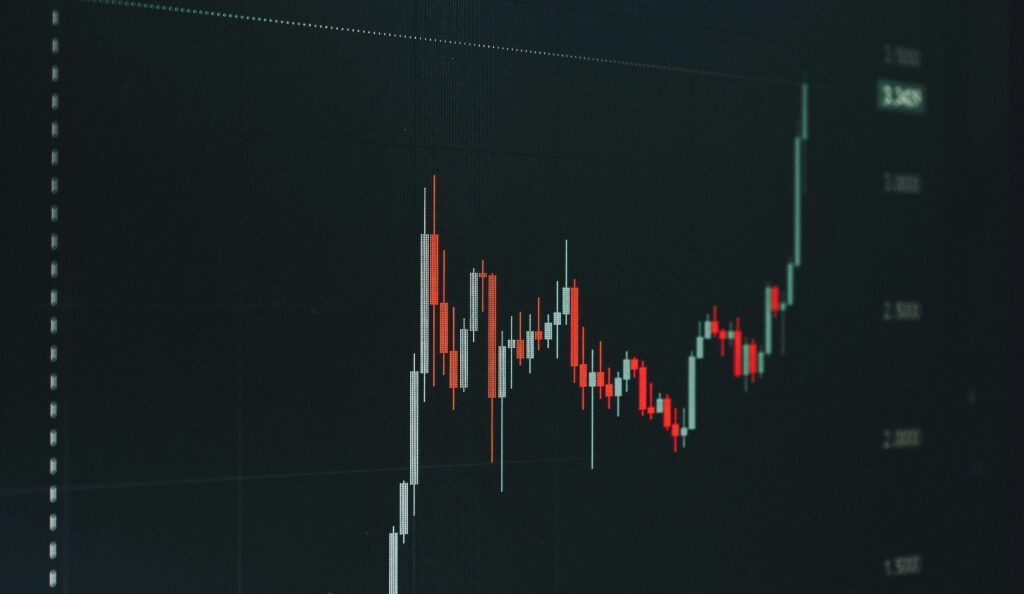
Are markets becoming more irrational?
Francis Galton once observed a game at a country fair over a century ago in which people had to guess the weight of an ox.
Individual guesses varied wildly, yet when he calculated the average of all the independent guesses, the crowd was remarkably accurate. You may have seen something similar yourself — for example, guessing how many pennies are in a jar. Your own estimate might be way off, but the average of many independent guesses is often close to the true number. This phenomenon was popularised by James Surowiecki in his book The Wisdom of Crowds.
Galton’s experiment relied on each guess being made independently. Modern financial markets, however, show what happens when decisions aren’t independent at all. Silicon Valley Bank (SVB) provides a striking example. SVB was founded in the 1980s to support the growing US tech sector in California. As the tech industry boomed, so did SVB, eventually becoming the 16th largest bank in the United States. On 8 March 2023, it announced a $2 billion share issue to shore up its capital base. Its depositors quickly concluded that something was amiss. On 9 March they withdrew $42 billion, leaving the bank with a $958 million overdraft and effectively insolvent. On 10 March, SVB was taken over by US authorities. It was the biggest and fastest bank run in history.
More people than ever are investing directly in stock markets — so why do markets feel more unpredictable? Cliff Asness, the “rock star” statistician and co-founder of AQR, monitors the valuation gap between the most expensive 30% of large US stocks (on a price-to-book basis) and the cheapest 30%. For 50 years from 1950, this spread behaved reasonably predictably. But in 2000, during the dot-com bubble, the difference exploded.
Statisticians expect an extreme event roughly once every 50 years. Yet in 2020/21 the market appeared to “go bananas” again, as the chart shows. What made the latest episode more painful was its duration: the longer the distortion persisted, the harder it became to hold cheaper, value-oriented stocks. A fund manager might survive poor results when the whole market is struggling, but few survive underperformance in a rising market — and that is more or less what happened to Cliff Asness and AQR at the time.

Taken from The Less Efficient Market Hypothesis. Cliff Asness 3/9/2024
Of course, as another well-known book argues, we may simply be Fooled by Randomness. Surprises happen, and there is no rule saying they must occur neatly once every 50 years; indeed, if they did, they would hardly be surprises. Nevertheless, some irrationality does seem to be creeping into markets. The frenzy around non-fungible tokens, and the sudden popularity of companies flirting with bankruptcy such as GameStop or AMC, suggests something new is influencing behaviour and increasing unpredictability.
Some point to the rise of passive investing, but that does not explain the mania in GameStop, nor the expansion of the valuation gap between the priciest and cheapest stocks — passive funds buy everything in proportion, regardless. A more compelling explanation is Nobel laureate Richard Thaler’s “bored market hypothesis”: vast numbers of small investors can now trade at minimal cost, and many find index investing dull. They drift towards social media, where they form online communities, swap stories, and share exciting ideas.
When markets are near all-time highs, many retail investors are sitting on profits — what they see as casino-like “house money”, which feels easier to gamble with. Combine this with social-media encouragement and the bored market hypothesis, and it’s no surprise some investors begin to act recklessly, or as Cliff Asness neatly puts it, “cray cray”.
In Galton’s county-fair experiment, the guesses were all made independently. Social media is the opposite: ideas can go viral, and instead of the wisdom of crowds we get the madness of crowds. The same dynamic applied to SVB: its customers were largely from the same tech-centric social circle and consumed the same online commentary. Their decisions to withdraw funds were not made independently — and rather than queue outside a branch, Northern Rock-style, they moved billions with a few taps online.
What does all this mean for the market today and your investment portfolio? Inevitably the “cray cray” markets will deter some investors altogether, and drag others into the madness at the worst possible moment. While regrettable, however, this does create opportunities: history has shown that long-term returns are greater for those who can stay the course.

Please be aware that the value of investments may go up or down and you may receive back less than you invested originally. Past performance is not a guide to the future.
This document contains general information only and does not provide any advice or guidance specific to your personal circumstances.
Callanish Capital is authorised and regulated by the Financial Conduct Authority to manage investments but does not provide Financial Planning or Investment Advice. Please refer any such queries to your Financial Advisor.
This email and any accompanying attachment are issued by Callanish Capital Ltd, a company registered in England and Wales under company number 13182424. Registered Office: 45 Pont Street, London, SW1X 0BD.
Callanish Capital Ltd is a Discretionary Fund Manager, directly authorised and regulated by the Financial Conduct Authority (“FCA”) under registration number 955992.